|

DAIMYO of
SUWO PROVINCE
Kikkawa

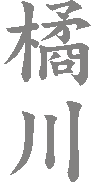
- Domain: Iwakuni
- Stipend: 60,000 koku
- Class: Tozama 5
- Headquarters: Iwakuni Castle (Mountaintop)
%20800x516.jpg)
%20450x600.jpg)
.jpg)
Family of daimyo descended from the Fujiwara.
Succession
- Motoharu (1530-1586)
- Hiroie (1561-1625; daimyo 1587-1616) - 1st Kikkawa daimyo of Iwakuni
- Hiromasa
- Hiroyoshi
- Hironori
- Hiromichi
- Tsunenaga
- Tsunetomo
- Tsunetada
- Tsunekata
- Tsunehira
- Tsuneakira
- Tsunemoto
- Tsunetake
Notable Ancestors
-
Kikkawa
Motoharu (1530-1586)
%20256x599.jpg)
2nd son of Mori Motonari, was adopted by Kikkawa Okitsune; distinguished
himself in the wars waged by his father to extend his domains. In 1578,
victorious over
Amako Katsuhisa, he seized the provinces of Izumo, Hoki, Tajima, and Inaba. Later
on, Motoharu fought two years against Hideyoshi, whom Nobunaga
had sent to reduce the Mori. In 1582 peace was restored on the death of
Nobunaga. After that, Motoharu fell sick, ceded his domains to his son Motonaga,
and retired to Kokura, where he died.
-
Kikkawa
Hiroie (1561-1625)
3rd son of Motoharu, in 1583 repaired to Kyoto and received the title of
Kurando. He succeeded his brother Motonaga, who had died without offspring,
and enjoyed a revenue of 200,000 koku at Toda (Izumo). In 1588 Hideyoshi made him
marry the sister of Ukita Hideie, who he had adopted, and gave him the name of
Toyotomi. He served in the expedition to Korea (1592), with his cousin
Mori Terumoto. In 1600, having sided against Ieyasu, he was dispossessed. His
younger brother Hiromasa received from the Mori family a revenue of 60,000
koku at Iwakuni (Suwo), where his descendants resided.
Sources
Mori


- Domain: Tokuyama
- Stipend: 40,000 koku
- Class: Tozama 5
- Headquarters: Tokuyama Castle
Daimyo family issued from the province of Aki and descended from Oe
Hiromoto (1148-1225).
Junior branch issued from Naritaka (1603-1680), Hyuga no kami, 2nd son of
Terumoto. From 1634 it resided at Tokuyama.
Succession
- Suemitsu ( -1221)
- ...
- Tokichika
- ...
- Motonari (1497-1571)
- Takamoto (1523-1563)
- Terumoto (1553-1625)
- Naritaka (1603-1680) - 1st Mori daimyo of Tokuyama
- Motokata
- Mototsugu
- Mototaka
- Hirotoyo
- Hirotomo
- Takayoshi
- Hiroshige
- Motomitsu
Notable Ancestors
Son of Hiromoto, the first to take the name of Mori.
Grandson of Suemitsu, settled at Yoshida (Aki).
-
Mori
Motonari (1497-1571)
.jpg)
Descendant of Tokichika in the 9th generation. Resided at Sarukake, in the
district of Tajihi (Aki). Having had a quarrel with his suzerain Amako
Tsunehisa, he joined Ouchi Yoshitaka and fought against him. Ouchi, having
been killed by his vassal Sue Harukata (1551), Motonari entered the lists
against Harukata, defeated and killed him (1555); after this, he gradually
occupied the domains of the Ouchi, besieged Yoshinaga in Yamaguchi (Suwo) and in
1557
conquered the city. At that time, the financial state of the empire
was in such a poor condition that the new emperor Ogimachi had to wait two
years before he could be crowned; in 1560 Motonari took upon himself the
expenses connected with the ceremony and received in acknowledgment of his
services the title of Daizen-tayu and the privilege to bear on his escutcheon
the imperial chrysanthemum and paulownia. Meanwhile, his sons were fighting
for him in all directions: nearly the whole San'yodo and the San'indo were under
his power. War broke out between him and Otomo Sorin, the most poweful of the
Kyushu daimyo, but the Shogun Yoshiteru acted as mediator between them: a
daughter of Sorin was betrothed to the grandson of Motonari, who was to keep
only the castle of Moji (Buzen) in Kyushu. On the other side, the Amako
continued their resistance to their ancient vassal; Motonari invaded Izumo,
and after a long siege occupied the castle of Toda; the last of the Amoko,
Yoshihisa, was confined in Aki, and Motonari became master of ten provinces;
he has, on this account, been called ju-koku no taishu (1566). He was the
father of nine sons; the eldest, Takamoto, having died, Motonari was succeeded
by his grandson, Terumoto.
-
Mori
Takamoto (1523-1563)
Eldest son of Motonari, helped his father in different campaigns, himself
conquered Bitchu and governed the provinces of Nagato, Aki, and Bingo. He died
before his father, at the age of 41.
-
Mori
Terumoto (1553-1625)
.jpg)
Son of Takamoto, succeeded his grandfather Motonari. In 1570, with the help
of his uncles Kikkawa Motoharu and Kobayakawa Takakage, he raised an army
against Amako Katsuhisa and Yamanaka Yukimori, and beseiged them in the castle
of Suetsugu (Izumo). Having heard that his grandfather was dangerously ill, he
left the command of the troops to Motoharu and hastened with Takakage to come
to Motonari. When Suetsugu surrendered, Yukimori was taken prisoner and sent
to Odaka (Hoki), whence he was able to make his escape; Katsuhisa fled to the
Oki islands and from thence went to Kyoto. In 1573 the Shogun Yoshiaki,
deposed by Nobunaga, sought shelter near Terumoto. Nobunaga, displeased,
helped Katsuhisa and Yukimoro and enabled them to carry on the war: they
invaded Tajima, and Yamana Toyokuni joined them; in Inaba, they fortified
themselves in the castle of Tottori. Motoharu marched against them and
Toyokuni surrendered whilst Katsuhisa fortified himself in Wakasa. In 1575,
the
following year, Terumoto brought fresh supplies to Motoharu and
Katsuhisa again entered Tajima. Two years later, Katsuhisa and Yukimori,
re-entered the field, and forming the vanguard of Hideyoshi's army, they
stopped at the castle of Kozuki (Harima); Terumoto came and besieged them;
they were soon reduced to the last extremity and in 1578 Katsuhisa committed harakiri. Meanwhile, Hideyoshi was advancing, and having traversed Inaba, laid
siege to the castle of Takamatsu, defended by Shimizu Muneharu, Terumoto's
vassal. Having stormed the place, he sent the bonze Ankokuji Ekei to Terumoto
to make peace. Whilst the deliberations were pending, Hideyoshi received the
news of the assassination of Nobunaga. He at once invited Muneharu to commit
harakiri, and announced his intention to Terumoto to continue the war:
Takakage however brought his nephew to accept the proposition of peace. In
1587 Terumoto assisted in the Kyushu expedition against the Shimazu. In 1591
he built the castle of Hiroshima and used it as his residence; he now had a
revenue of 1,200,000 koku. Before dying, Hideyoshi chose him as one of
the five Tairo who were to form the regency during the minority of his son
Hideyori. In 1600 he fought against Ieyasu and during the campaign of
Sekigahara, he was intrusted with the castle of Osaka. On the news of the
defeat of his allies, he surendered at once, and to gain favor with the
victor, he went so far as to behead the son of Konishi Yukinaga, who had been
intrusted to him. This shameful villainy did not soften Ieyasu, who took eight
provinces from him, and left him only Nagato and Suwo with a revenue 369,000
koku. Soon after, Terumoto shaved his head, took the name of Sozui, and left
his domains to his son.
Related Branches
- Senior branch: Hagi (Choshu) (Nagato -- 369,000 koku)
- Branch: Chofu (Nagato -- 50,000 koku)
- Branch: Kiyosue (Nagato -- 10,000 koku)
Sources
|
![[Company Logo Image]](../images/Feudal%20Japan%20Logo.gif)



.jpg)
.jpg)
.jpg)